Peer Review Process
Peer Review Process for International Scientific Technical and Economic Research
International Scientific Technical and Economic Research employs a double-blind peer review system. All manuscripts must undergo rigorous peer review prior to publication. The final decision regarding acceptance rests with the Editor-in-Chief, a policy that applies to all submissions, including those for special issues.
How peer review works
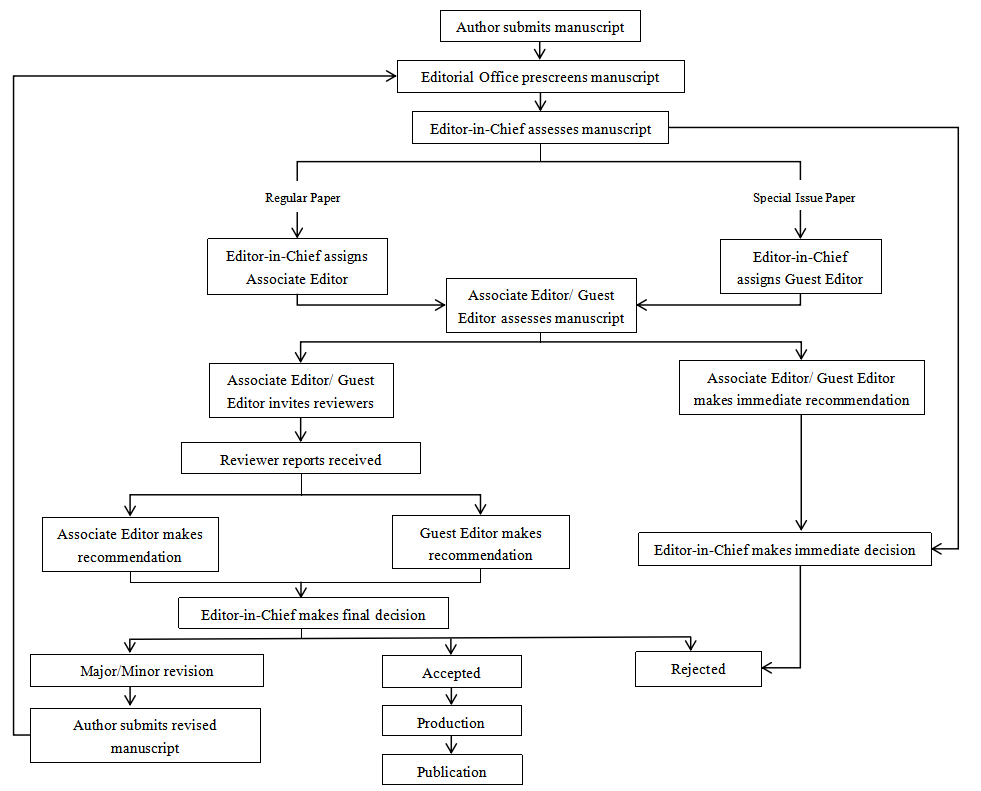
1. Submission and Editorial Office Pre-check: Upon submission, the editorial office conducts a technical check to verify that the manuscript conforms to the journal's template, word count, and scope requirements. Simultaneously, the manuscript undergoes originality screening using the Turnitin similarity detection service. The overall text similarity (excluding the bibliography) must be below 20% to proceed to the next stage.
2. Initial Assessment by the Editor-in-Chief: Manuscripts passing the pre-check are assessed by the Editor-in-Chief for initial suitability. This evaluation considers alignment with the journal's aims and scope, methodological rigor, and clarity of presentation. The Editor-in-Chief may decide to reject the manuscript at this stage.
3. Assignment to an Editor: Manuscripts passing the initial assessment are assigned by the Editor-in-Chief to an appropriate Associate Editor or Guest Editor (for special issues) based on the subject area.
4. Assessment by the Associate/Guest Editor: The assigned editor evaluates the manuscript's suitability for peer review and may recommend rejection to the Editor-in-Chief at this point.
5. Invitation to Reviewers: If deemed suitable, the editor will invite at least two independent external reviewers with relevant expertise to conduct a double-blind review. In this model, the identities of both authors and reviewers are concealed from each other throughout the process.
6. Review and Collation of Reports: The editor collects and reviews the reports from at least two reviewers. If reviews are substantially conflicting, the editor may invite an additional reviewer to obtain a more comprehensive assessment.
7. Editorial Decision: Based on the reviewers' reports and their own evaluation, the Editor-in-Chief makes a preliminary decision, which may be: Reject, Accept, Accept after Minor Revisions, or Reconsider after Major Revisions.
8. Author Revision and Re-evaluation: If revisions are required, the corresponding author receives the anonymous reviewer comments and the editorial decision. A revised manuscript and a point-by-point response must be submitted within the specified deadline. The revised version is typically re-evaluated by the original editor and/or reviewers. The Editor-in-Chief makes the final acceptance or rejection decision based on this re-evaluation.
9. Acceptance and Production: Upon final acceptance, the manuscript is transferred to the production team for language polishing (if needed), copyediting, and typesetting.
10. Author Proofing: The corresponding author receives a proof of the typeset article and is required to check and confirm all content or return necessary corrections within 5 business days.
Plagiarism Screening
The journal uses the Turnitin system to screen all submissions for originality. Authors must ensure their work is highly original, with proper citation and acknowledgment of all sources. We require the overall similarity score (excluding the bibliography) to be below 20%. Any suspected plagiarism or academic misconduct will result in immediate rejection and may be reported to the authors' institution(s).


 X (FORMERLY TWITTER)